Ibai
Legado en los huesosIbai, the son of Amaia Salazar and James, enters the story as a newborn whose arrival gives shape to Amaia’s hopes and fears about motherhood. His early life is marked by ordinary acts of care—feeding, carrying, and watching over him—but those acts acquire unusual weight against the family’s history of trauma. When his safety is threatened, the child whom Amaia has feared she may fail to protect becomes the clearest measure of what she is determined to defend.
Birth and identity
Ibai’s birth is marked by a strong cry, which the narration presents as an emphatic arrival. Amaia recognizes that the baby is a boy and tells James so. The midwife is surprised that the couple apparently did not know the child’s sex; she recalls Amaia repeating the name Ibai during labor and asks whether that is what they will call him. His name, then, is already bound to the experience of his birth, even before the adults have settled the question aloud.
The book also associates Ibai with the phrase the river child. At the story’s close, Amaia links the name and the circumstances of his birth to a prediction that the child was expected to be a girl but became a boy at the last moment. These descriptions give Ibai a place in the story’s language of foretelling, but they do not displace his identity as Amaia’s son: when she sees him in danger, her answer is grounded in that relationship and in her responsibility toward him.
A transition marked three months later places the reader beyond the birth scene and into the routines of caring for an infant. The change in time shifts attention from the event of his arrival to the sustained work of parenting. Ibai’s presence is no longer only a new fact in Amaia and James’s lives; it is a daily bond that affects how they organize their time and how Amaia understands herself.
Care and attachment
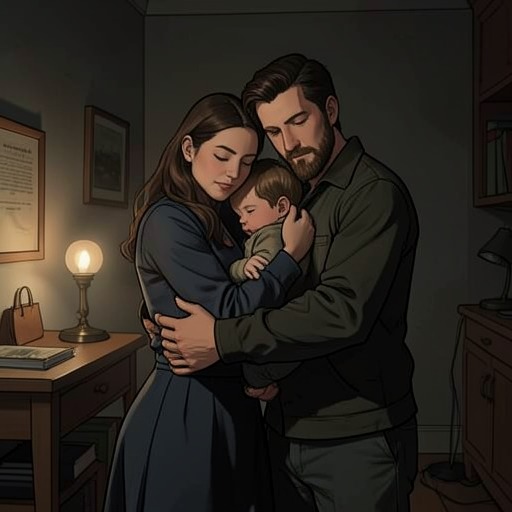
Amaia’s attachment to Ibai is expressed through physical closeness and delayed departures rather than through abstract declarations alone. Before going to the police station, she spends longer than usual saying goodbye, carrying him from room to room and postponing the moment she must leave. Nearly an hour later, she still feels the impression of his small body in her arms and misses him with an intensity she has never known before. The separation is brief, but the passage makes clear how completely the child has altered the emotional terms of her working day.
Care is shared with James. At Engrasi’s home, Amaia reports that Ibai is asleep after James has given him a bottle and carried him upstairs; a baby monitor sits on the table. The scene places his care within a household network that includes Engrasi, rather than presenting motherhood as a task Amaia performs alone. Elsewhere, Amaia feeds Ibai, holds him upright until he burps, and settles him again in her arms. These practical gestures let the scene show intimacy as repeated attention to his needs.
That attention exists alongside Amaia’s private doubts. She remembers loving the idea of being a good mother since childhood, yet now fears that her love may not be enough and that she is not worthy of the role. She wonders whether a darker inheritance runs through the women in her family. Ibai does not cause this fear; his importance exposes it. Her desire to care for him is certain, while her confidence in her own ability to do so remains painfully unsettled.
Family life and responsibility
The novel repeatedly sets Ibai within shared domestic moments. Amaia wakes after an unplanned sleep and checks on him while James sleeps nearby; she covers her husband before leaving the room. During a winter walk through Elizondo, Amaia and James discuss progress on the Juanitaenea project while Ibai sleeps in his stroller. The scene joins the ordinary rhythms of family life to the continuing concerns of the larger story: the child is present as they talk, even when the subject is work beyond the immediate task of caring for him.
For Amaia, becoming a parent also changes the perceived cost of her police work. While driving, she thinks about the responsibility of leaving Ibai without his mother and asks herself whether that responsibility should limit how she works or how fast she drives. She eases off the accelerator. The moment does not show her abandoning her profession; it shows her registering that professional risk now has a consequence that extends beyond herself. Parenthood enters her decisions as a real constraint, not merely a tender feeling.
James’s conduct around Ibai also reveals a shared bond. When Amaia meets them by the garden, James is waiting with the stroller and carries an unusual seriousness. Amaia first kisses the sleeping child’s hand, then steps aside to speak with her husband. Later, she greets both James and Ibai affectionately and takes the child into her arms while remaining close to James. These moments place the parents together in care, even as the novel shows that Amaia’s work can pull her attention away from home.
Threat and Amaia’s response
Ibai becomes the central stake in the final emergency when Amaia concludes that Rosario has been released in order to kill him. James is away in Bilbao, and Amaia fears that Ibai is alone with Engrasi. Her alarm is sharpened by the possibility that the earlier investigation has distracted the police from a danger directed at her own family. The threat turns the balance between work and parenthood into an immediate crisis: the responsibility she had considered in private now demands action.
When Amaia reaches Ibai, she hears signs of movement and one of his familiar little sounds, and understands that he is alive. She then sees him lying in the middle of an intricate design marked out in white material and surrounded by candles. He is wearing only a diaper. The scene places the infant at the center of a deliberate, threatening arrangement, contrasting his vulnerability with the controlled pattern around him. The evidence of life brings Amaia relief, but the setting makes plain that reaching him has not made the danger ordinary or harmless.
Amaia answers the crisis by affirming that Ibai is her son. The statement is more than identification: in that moment, it becomes a declaration of purpose. Her earlier fear that she might be unworthy of motherhood does not vanish through a sudden resolution of every doubt. Instead, the novel gives her a concrete choice in the face of danger. Ibai’s significance lies both in the care he receives and in what his peril draws out of Amaia: a firm claim of kinship and a readiness to protect him.